1 2 3 5 7 9 Arithmetic Sequence Question Video Finding The Number Of Terms That Make The Sum Of A WORKSHEET Arithmetic Sequence Series Word Problems How To Find The Number Of Terms In A Arithmetic Sequence An How To Write A Formula For An Arithmetic Sequence Writerstable web Arithmetic Sequence A Maths Dictionary For Kids Quick Reference By Ian Pulizzotto Actually the explicit formula for an arithmetic sequence is a n a n 1 D and the recursive formula is a n a n 1 D instead of a n a D n 1 The difference is than an explicit formula gives the nth term of the sequence as a function of n alone whereas a recursive formula gives the nth term of a sequence as a
This arithmetic sequence calculator can help you find a specific number within an arithmetic progression and all the other figures if you specify the first number common difference step and which number order to obtain For example the sequence 3 6 9 12 15 18 21 24 is an arithmetic progression having a common difference of 3 Examples of How to Apply the Arithmetic Sequence Formula Example 1 Find the 35 th term in the arithmetic sequence 3 9 15 21 There are three things needed in order to find the 35 th term using the formula the first term latex a 1 latex the common difference between consecutive terms latex d latex
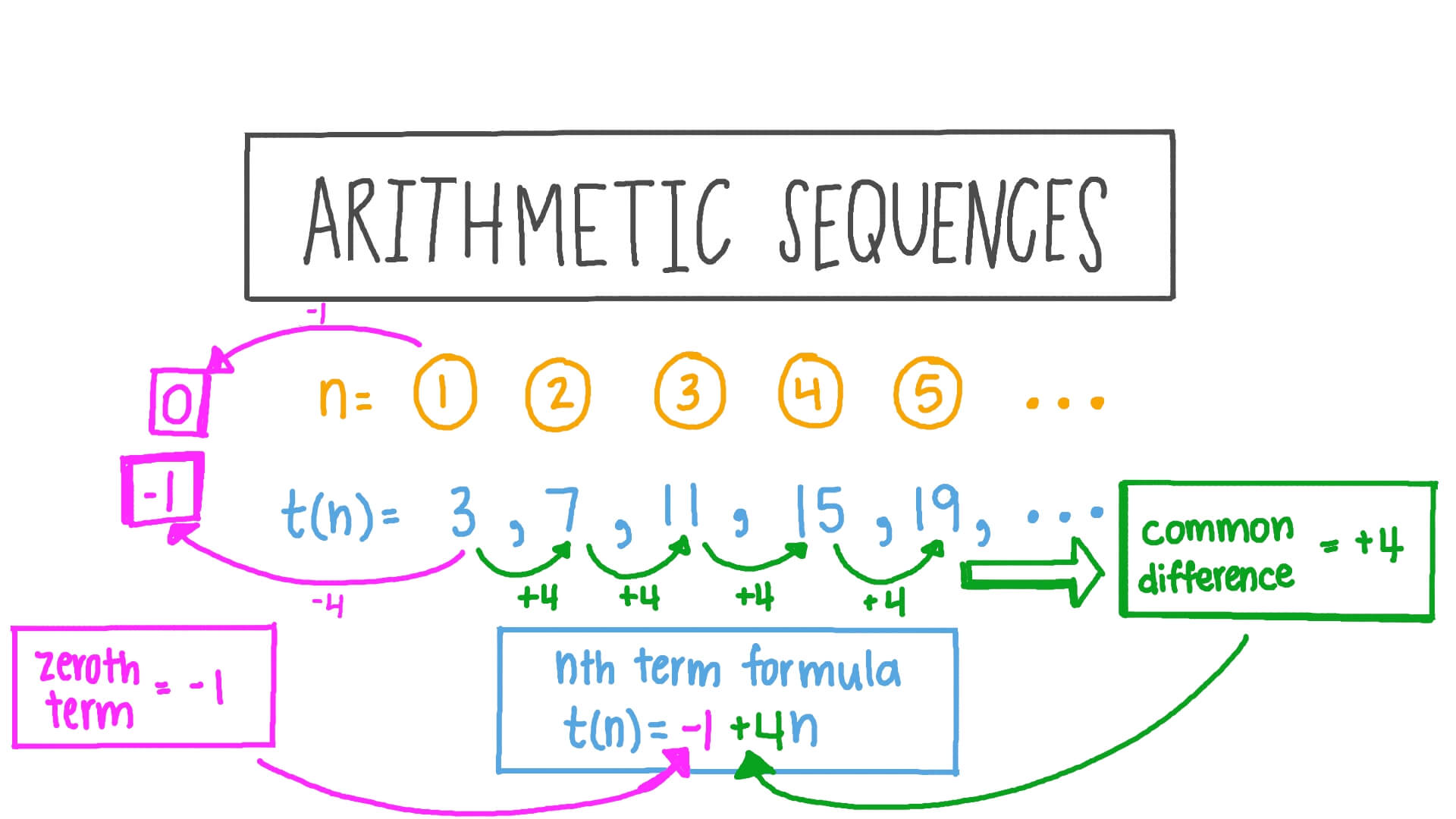
Arithmetic Sequence A Maths Dictionary For Kids Quick Reference By Arithmetic Sequence Worksheet Answers 1 N 100 Arithmetic Sequences Arithmetic Sequence Worksheet 1 Db excel Arithmetic Sequences And Series examples Solutions Videos Question Video Finding The Arithmetic Sequence Under A Certain Arithmetic Sequence And Series Arithmetic Sequence And Series
1 2 3 5 7 9 Arithmetic Sequence
 1 2 3 5 7 9 Arithmetic Sequence
https://media.nagwa.com/964167502805/en/thumbnail_l.jpeg
The first term of an arithmetic sequence is equal to frac 5 2 and the common difference is equal to 2 Find the value of the 20 th term example 3 ex 3 An arithmetic sequence has a common difference equal to 7 and its 8 th term is equal to 43 Find its first term
Pre-crafted templates use a time-saving solution for creating a diverse range of files and files. These pre-designed formats and layouts can be used for different personal and professional projects, including resumes, invitations, flyers, newsletters, reports, presentations, and more, enhancing the material development process.
1 2 3 5 7 9 Arithmetic Sequence

NCERT Class 10 Mathematics Solutions Chapter 5 Arithmetic Progressions
Arithmetic Sequence Worksheet Answers

1 N 100
Arithmetic Sequences
Arithmetic Sequences And Series examples Solutions Videos

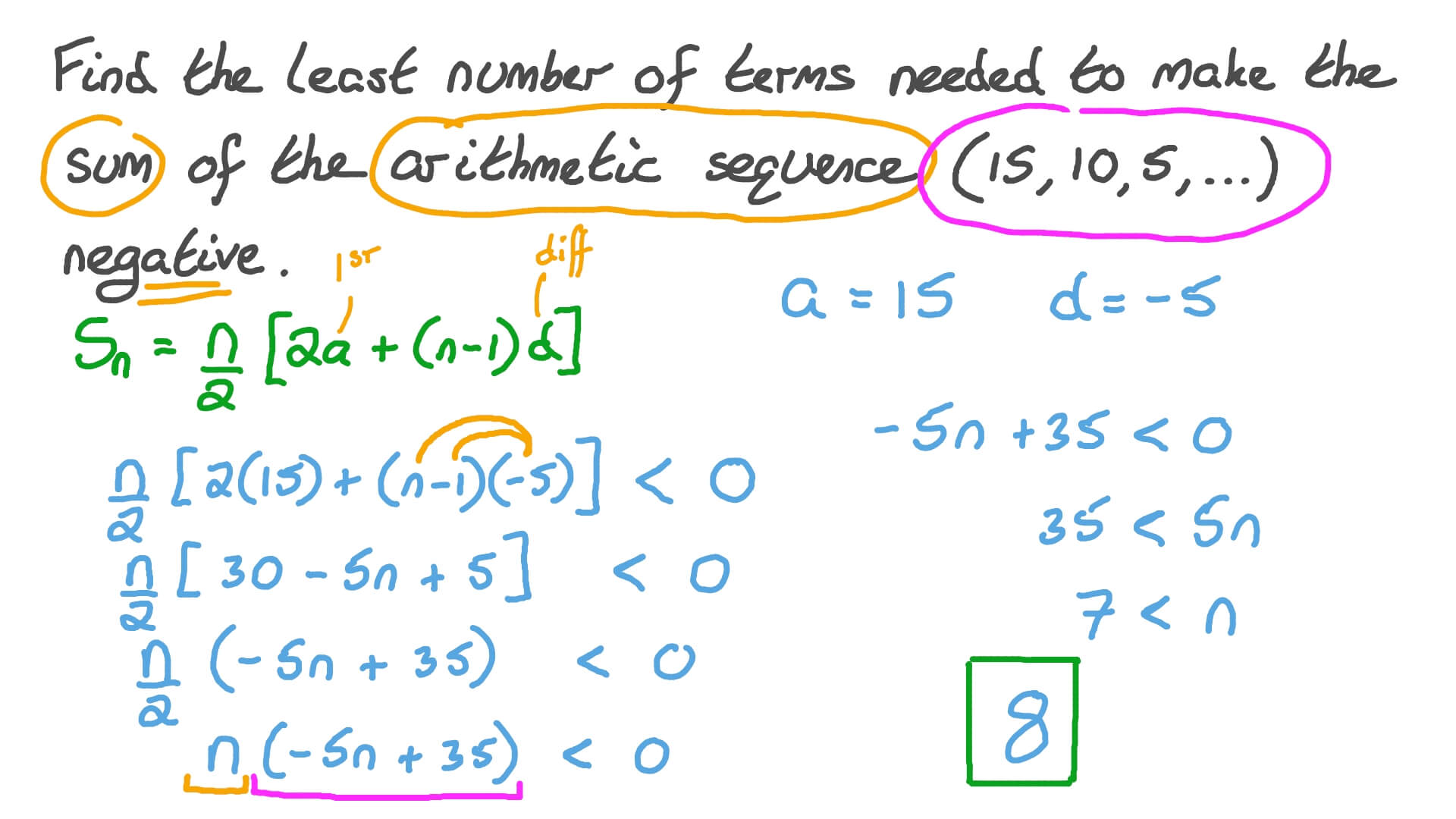
Question Video Finding The Arithmetic Sequence Under A Certain

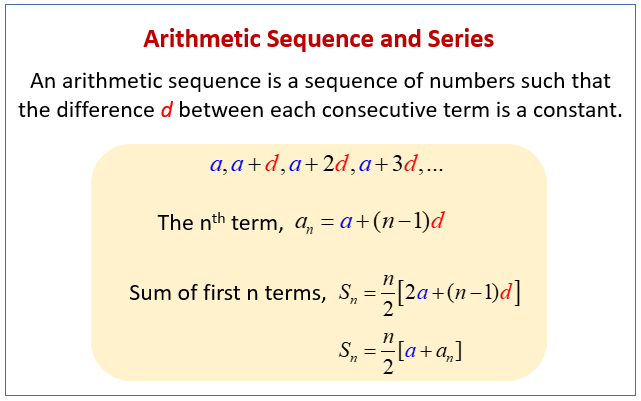
What is an arithmetic Sequence An arithmetic sequence is a sequence of numbers in which each term is obtained by adding a fixed number to the previous term It is represented by the formula a n a 1 n 1 d where a 1 is the first term of the sequence a n is the nth term of the sequence and d is the common difference which is obtained by

The Sequence Calculator finds the equation of the sequence and also allows you to view the next terms in the sequence Arithmetic Sequence Formula a n a 1 d n 1 Geometric Sequence Formula a n a 1 r n 1 Step 2 Click the blue arrow to submit Choose Identify the Sequence from the topic selector and click to see the result in our

1 1 3 3 5 5 7 7 9 9 This is an arithmetic sequence since there is a common difference between each term In this case adding 2 2 to the previous term in the sequence gives the next term In other words an a1 d n 1 a n a 1 d n 1 Arithmetic Sequence d 2 d 2 This is the formula of an arithmetic sequence

An arithmetic sequence uses addition subtraction of a common value to create the next term in the sequence A geometric sequences uses multiplication division of a common value to create the next term in the sequence Hope this helps Learn for free about math art computer programming economics physics chemistry biology medicine finance
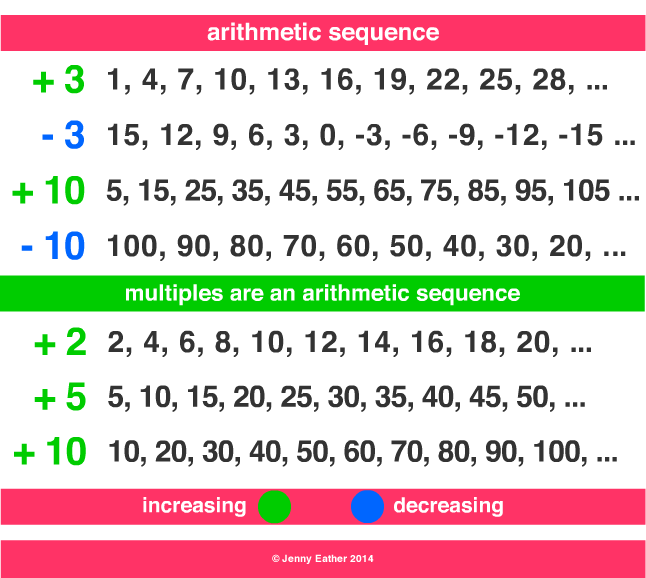
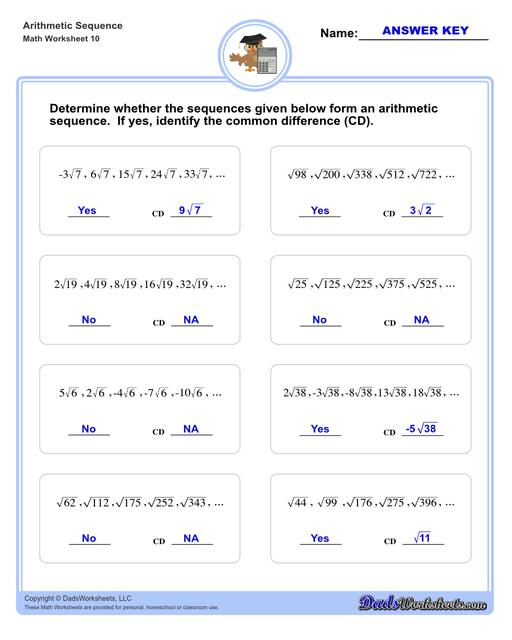
An arithmetic sequence is a number sequence in which the difference between each successive term remains constant This difference can either be positive or negative and dependent on the sign will result in terms of the arithmetic sequence tending towards positive or negative infinity 1 3 5 7 9 25 5 1 9 2 50 2 25
What will be the formula for finding the nth term of a series in which the difference between the terms increase by 1 after every k elements For example for k 3 1 2 3 5 7 9 12 15 18 k 2 1 2 4 6 9 12 16 20 25 i found some formula for smaller values of k 2 3 4 5 for k 1 floor 2n 1 2n 1 8 k 2 floor n 1 n 1 4 This sequence is the same as the one that is given in Example 2 There we found that a 3 d 5 and n 50 So we have to find the sum of the 50 terms of the given arithmetic series S n n 2 a 1 a n S 50 50 3 248 2 6275 Answer The sum of the given arithmetic sequence is 6275
Here is an explicit formula of the sequence 3 5 7 a n 3 2 n 1 In the formula n is any term number and a n is the n th term This formula allows us to simply plug in the number of the term we are interested in and we will get the value of that term In order to find the fifth term for example we need to plug n 5