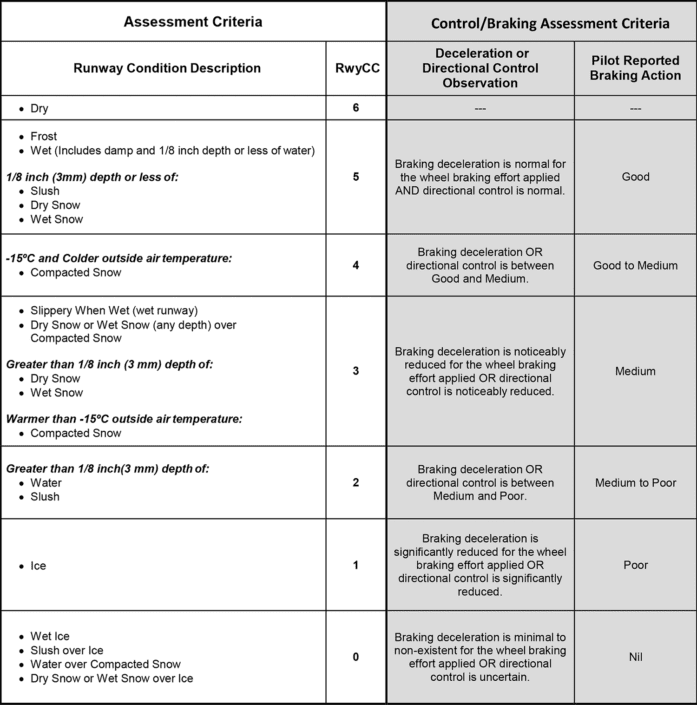
Runway Condition Codes Faa Snow On The Runway Here s How To Interpret Runway Condition Codes FAA Developing New Runway Condition Report Process EVO Jet Services Cracking The Code Understanding Runway Condition Codes Snow On The Runway Here s How To Interpret Runway Condition Codes Relational Plot Of Weather And Runway Condition Codes At KBGR In 2018 Runway condition code RwyCC values range from 1 poor to 6 dry For frozen contaminants on runway surfaces a runway condition code reading of 4 indicates the level when braking deceleration or directional control is between good and medium
Issue 4 2021 Cracking the Code Understanding Runway Condition Codes From Transport Canada by TCCA GRF Implementation Team Guy H neault Drew Dutton Robert Kostecka Cheryl Bugden Aerodrome Standards and Benoit Saulnier Commercial Flight Standards FAA Federal Aviation Administration United States FAR Federal Aviation Regulations United States FTF Friction Task Force HF H igh frequency RWYCC Runway condition code x ICAO Circular 355 x ICAO Circular 000 AN 000 x ICAO Circular 000 AN 000
Relational Plot Of Weather And Runway Condition Codes At KBGR In 2018 Pilot Reported Braking Action And Runway Condition Codes n 9 580 Coming Soon A New Global Format For Runway Surface Conditions FICON Reports Heatmap For Enumerated PIREP BA Vs RwyCC Slope n 4 420 Download This Standardized Runway Reporting Format Will Enhance Aviation Safety GLOBAL REPORTING FORMAT GRF Flyco Global FAA Vs ICAO Braking Action Runway Condition Flying With Tools FAA Vs ICAO Braking Action Runway Condition Flying With Tools
Runway Condition Codes Faa
 Runway Condition Codes Faa
https://studentpltnews-images.s3.us-east-2.amazonaws.com/wp-content/uploads/2019/11/05171544/IMG_1711-scaled.jpg
The purpose of this notice is to prescribe direction used to format and distribute information regarding unanticipated or temporary changes to services components of or hazards in the National Airspace System NAS pertaining to runway environment conditions using Takeoff and Landing Performance Assessment TALPA standards Audience
Templates are pre-designed files or files that can be utilized for various purposes. They can save effort and time by supplying a ready-made format and layout for creating various kinds of content. Templates can be utilized for individual or expert jobs, such as resumes, invites, leaflets, newsletters, reports, presentations, and more.
Runway Condition Codes Faa

AIC 01 21 IMPLEMENTATION OF THE GLOBAL REPORTING FORMAT GRF
Pilot Reported Braking Action And Runway Condition Codes n 9 580

Coming Soon A New Global Format For Runway Surface Conditions
FICON Reports

This Standardized Runway Reporting Format Will Enhance Aviation Safety

GLOBAL REPORTING FORMAT GRF Flyco Global
Be used and must support the higher runway condition code This ability to raise the repolted runway condition code to a code l 2 or 3 can only be applied to those runway conditions listed under codes 0 and I in the Matlix The ailP01t operator must also continually monitor the lunway surface as long as the higher code is in effect to ensure

The Takeoff and Landing Performance Assessment TALPA initiative reduces the risk of runway overruns by providing airport operators with a method to accurately and consistently determine runway conditions when a paved runway is not dry

Starting October 1 2016 the same NOTAM with contaminants would be reported using Runway Conditions Codes as follows DEN RWY 17R FICON 5 5 3 25 PRCT 1 8 IN DRY SN 25 PRCT 1 8 IN DRY SN 50 PRCT 2 IN DRY SN OBSERVED AT 1601010139 1601010151 1601020145
Note Runway condition codes one for each third of the landing surface for example 4 3 3 represent the runway condition description as reported by the airport operator The reporting of codes by runway thirds is expected to begin in October of 2016
Federal Aviation Administration Advisory Circular Subject Airport Field Condition Assessments and Winter Operations Safety Date 10 29 2020 Initiated By AAS 300 differ from the process of upgrading a Runway Condition Code 8 Clarifies the use of Conditions Not Monitored NOTAMs in paragraph 5 12 and adds an example and translation language
This briefing discusses how pilots apply Field Condition NOTAMs and Runway Condition Codes RwyCC to assess takeoff and landing performance on contaminated runways and how to use the Runway Condition Matrix RCAM and Pilot Braking Reports as decision making tools 26 20 TALPA Level 5 Applying TALPA Watch on Articles RWYCC The two columns are used to determine the correct RWYCC This column describes runway surface conditions and contaminants least to most slippery that are directly correlated to aeroplane takeoff and landing performance Contaminants have different effects depending on their depth and outside air temperature
5 Starting on October 1st 2016 the FAA is moving away from providing Mu values for runway friction reports to a new format showing contamination type and depth for each third of the runway Along with the report is a code X X X showing runway condition codes for each third of the runway